A number of factors contribute to lead time calculations, such as programming capacity, quality planning, tooling availability, outside processing, and material sourcing. But an equally impactful consideration is how clearly project requirements are communicated upfront, as unclear specifications or inspection expectations can lead to delays.
Ricaurte Precision Inc. (RPI) builds lead times around real-time operational data and production workflows. This visibility helps us provide customers with accurate and realistic timelines.
What Contributes to Lead Times at RPI?
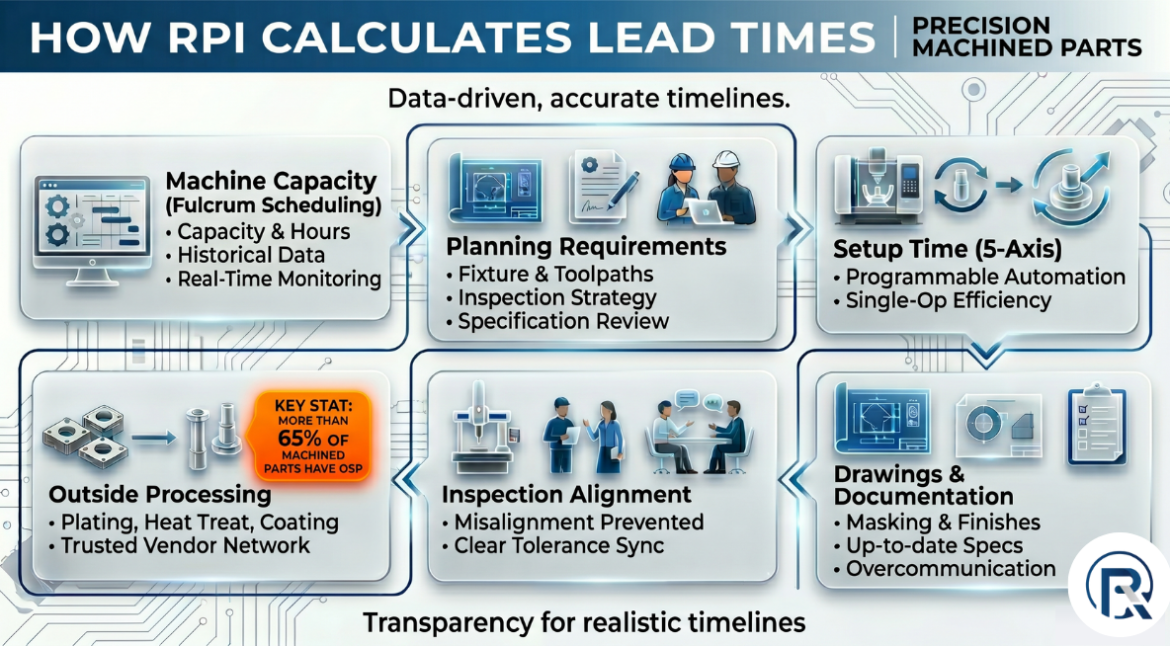
Machine Capacity
Using our Fulcrum scheduling system, our team organizes work based on machining requirements and part geometry. Then, once a job is categorized, the system evaluates available machining hours, setup capacity, and historical run data to determine realistic timelines.
Planning Requirements
New parts require significantly more engineering, programming, and quality review than repeat work. A new project might require:
- First article planning
- Fixture design
- Toolpath development
- Inspection strategy planning
- In-depth specification review
Just because a part looks simple to produce doesn’t mean it will be. For instance, a groove with a non-standard angle could require custom tooling or specialty inserts that aren’t readily available. In a complex precision machining environment like ours, even the smallest geometry changes can impact sourcing and machining strategy.
Setup Time
Our 5-axis machining and live tooling lathe systems allow parts to be completed in one or two operations instead of multiple setups across several machines. This is a major advantage for improving repeatability while reducing risk. But keep in mind that automation also requires investment in:
- Programming and validation: Complex setups may require several days of programming and proving out before production begins.
- Tooling and fixturing: Automated systems sometimes need specialized workholding or tooling strategies that take time to prepare.
Outside Processing
Approximately 65% of machined parts require some form of outside processing before they’re ready for delivery. To meet this demand, RPI relies on external vendors for processes like plating, anodizing, heat treating, passivation, and coating.
We’re happy to accommodate when our customers require approved suppliers, but greater flexibility in vendor selection allows us to move more aggressively. Our location in Southern California gives us access to a trusted network of suppliers just a short distance away, making part travel seamless and lead times minimal.
Inspection Alignment
One of the most overlooked causes of production delays is inspection misalignment. Sometimes contract manufacturers and customers measure the same feature differently due to different inspection tools or conflicting interpretations of tolerances.
Clear communication of your requirements can help prevent unnecessary part rejections or repeated inspections.
Clarity of Drawings and Documentation
Conflicting information between drawings, purchase orders, and revision notes can result in delays. Just as challenging, missing details around masking or finishing requirements can lead to confusion and complications.
One of the best ways customers can improve lead times is by overcommunicating with their supplier.
You’ve probably heard the expression “a picture is worth a thousand words” before, and it’s certainly the case when communicating requirements with your supplier. Our team especially benefits from visual instructions when available. Masking diagrams and finish references can significantly reduce ambiguity.
In addition, it’s critical to provide your contract manufacturer with up-to-date specifications, as obsolete callouts can stall production while teams work on verifying requirements.
What This Means for Your Next Project
Lead times are the result of hundreds of decisions happening behind the scenes. RPI’s combination of digital scheduling tools, precision machining services, quality systems, and supplier management allows us to provide our customers with realistic timelines while maintaining flexibility for complex projects.
If you’re looking for a manufacturing partner that prioritizes transparency, reach out to RPI’s expert team to get started.